
OEM vs. Aftermarket Parts in Collision Repair: A California Driver’s Guide
When you read your collision repair estimate, you may see terms like “OEM,” “A/M,” “LKQ” or “reconditioned.” These describe where each replacement part comes from, and they can affect fit, finish and how your car performs in a future crash. Here’s a clear guide to the different types of parts, what California law requires, and how to make sure you know what’s going on your car.
What Are OEM Parts?
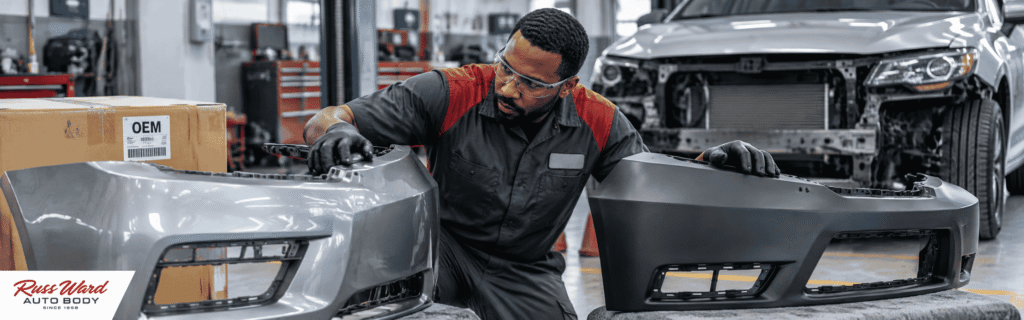
OEM stands for original equipment manufacturer. In California, an OEM crash part is one made for or by the company that built your vehicle. These are the same parts your car was built with, designed for its exact dimensions, materials and mounting points.
Advantages: precise fit, the same materials and crash performance the vehicle was engineered and tested with, and compatibility with sensors and brackets.
Drawbacks: they usually cost more, and some parts can take longer to arrive.
What Are Aftermarket (Non-OEM) Parts?
Aftermarket parts are made by companies other than the vehicle manufacturer. California calls them “non-OEM aftermarket crash parts.” Some are certified by independent programs such as CAPA, which tests for fit and materials; others are not certified at all.
Advantages: lower cost and often good availability.
Drawbacks: quality varies. Fit can be off, which may cause uneven panel gaps, extra labor to make them fit, or mounting issues for sensors and brackets. Material thickness and strength may differ from the original.
Other Part Types You May See
- Used / recycled (often listed as LKQ, “like kind and quality”): genuine OEM parts taken from another vehicle. They can be a good option when in good condition.
- Reconditioned or rebuilt: parts that have been repaired and refinished, such as bumper covers or wheels.
What California Law Requires
California has some of the strongest consumer protections in the country for collision parts:
- Your estimate must say what each part is. Under state rules, a new crash part listed on a body shop estimate is considered OEM unless it is specifically identified as a non-OEM aftermarket part. Used, rebuilt or reconditioned parts must be identified too.
- You must be told in writing. An insurer cannot require non-OEM aftermarket parts unless you are advised in a written estimate and the parts are identified with their manufacturer or distributor.
- Insurers must stand behind the parts they specify. California’s Fair Claims Settlement Practices Regulations say that if an insurer specifies non-OEM parts, it warrants that they are of like kind, quality, safety, fit and performance as OEM parts. It must also pay the cost of any modifications needed to make them fit.
Your insurance policy also matters. Some policies pay for aftermarket or used parts by default, while others (or optional endorsements) cover OEM parts. Read your policy and ask your agent.
Why It Matters for Safety and ADAS
Today’s bumpers, grilles and brackets often hold radar and camera sensors. A bracket that is a few millimeters off can change a sensor’s aim and affect safety systems like automatic emergency braking. Structural parts and high-strength steel or aluminum components should match the manufacturer’s design so the car performs as intended in a future collision. Learn more in our guide to ADAS calibration after collision repair.
How to Ask for OEM Parts
- Ask the shop to walk you through the parts list on your estimate.
- Check your policy for OEM coverage or an OEM endorsement.
- If you want OEM parts that your policy doesn’t cover, ask what the price difference would be. You may be able to pay it yourself.
- Ask the shop how it verifies fit and whether it follows manufacturer repair procedures.
Honest Parts Advice at Russ Ward Auto Body
At Russ Ward Auto Body, we explain every line of your estimate and identify each part’s type, as California law requires. We’ll tell you where we recommend OEM parts for fit and safety, and we’ll work with your adjuster on the details. You have the right to choose your own body shop in California, and you have the right to know what’s going on your car.
Explore our collision repair and insurance claim services, or call (714) 535-3739 to request an estimate. Visit us at 126 W Elm St, Anaheim, or our Estimate & Drop-Off Center at 2744 E Chapman Ave, Orange.
This article is general information, not legal advice.
Frequently Asked Questions
Are OEM parts better than aftermarket parts?
OEM parts are made for or by your vehicle’s manufacturer, so fit and materials match the original. Certified aftermarket parts can be acceptable, but quality varies more, and fit problems are more common.
Can my insurance company make my shop use aftermarket parts?
Your policy may limit what the insurer pays for, but in California the insurer must tell you in writing on the estimate when non-OEM parts are used, and it warrants that they are of like kind, quality, safety, fit and performance.
How can I tell which parts are on my estimate?
In California, a new part on a body shop estimate is OEM unless it is specifically identified as a non-OEM aftermarket part. Used, rebuilt and reconditioned parts must also be identified.
Do aftermarket parts affect my car’s warranty?
Using aftermarket parts doesn’t automatically void your whole vehicle warranty, but the manufacturer may not cover the aftermarket part itself or damage it causes. Ask your shop and check your warranty terms.
Can I pay the difference to get OEM parts?
Often, yes. If your policy covers aftermarket parts, you can usually ask the shop to install OEM parts and pay the price difference yourself.