
Most cars on the road today can see. Cameras behind the windshield, radar sensors behind the bumper and ultrasonic sensors around the body feed safety features like automatic emergency braking, lane-keep assist, adaptive cruise control and blind-spot monitoring. Together these are called advanced driver assistance systems, or ADAS. After a collision, these systems often need to be recalibrated so they “see” the road correctly again. Here’s what that means, when it’s needed, and what to ask your repair shop.
What Is ADAS Calibration?
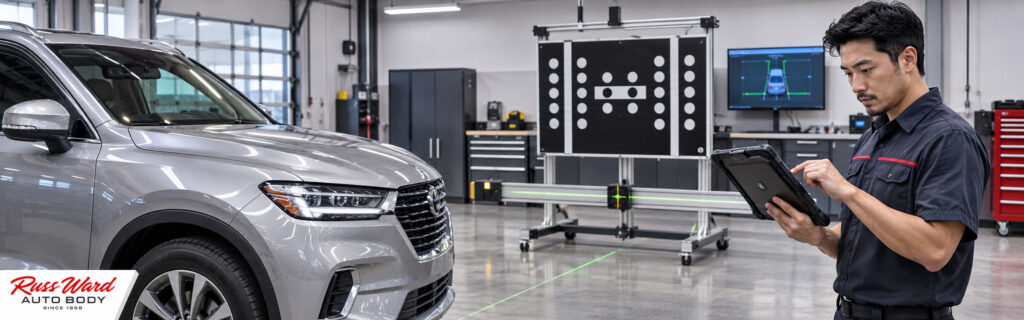
ADAS calibration is the process of aiming and verifying a vehicle’s cameras and sensors so they match the exact specifications set by the manufacturer. Each sensor has to know precisely where it is pointing relative to the car’s centerline and the road. Calibration is done with scan tools, special targets and measured setups, following the carmaker’s published procedure for that exact vehicle.
Why Collisions Throw Sensors Off
A sensor doesn’t have to be broken to be wrong. A small change in its angle can make a big difference at highway distances. A radar aimed slightly off can misjudge where another car is, and a camera looking a little too high or low can misread lane lines. Common causes after a crash include:
- A bumper cover or grille removed and reinstalled, moving the radar or parking sensors
- A replaced windshield, which moves the forward-facing camera
- A bent sensor bracket, mount or bumper reinforcement
- Frame or structural repair that changes the vehicle’s geometry
- A wheel alignment or suspension repair, which changes the car’s thrust angle
That last point surprises many drivers. Because many systems use the direction the wheels are pointing as a reference, an alignment can be enough to require calibration on some vehicles.
Warning Signs Your ADAS Needs Attention
- A dashboard warning light or a message like “front camera unavailable”
- Lane-keep assist that steers you toward the line instead of away from it
- Adaptive cruise control that brakes late, early or for no reason
- Automatic emergency braking alerts with nothing in front of you
- Blind-spot warnings that miss cars or alert constantly
Note that a system can also be off without any warning light at all. That is why the repair process matters more than the dashboard.
Static vs. Dynamic Calibration
There are two main types of calibration, and many vehicles require one, the other, or both:
- Static calibrationis done in the shop. The car is placed on a level floor and specific targets are set at measured distances and heights in front of or around it. The scan tool then guides the sensor to learn its correct aim.
- Dynamic calibrationis done on the road. A technician drives the vehicle under specific conditions (speed, clear lane markings, distance) while the scan tool monitors the sensor as it calibrates itself.
The manufacturer’s repair information decides which method is needed. A good shop doesn’t guess.
The Role of Pre- and Post-Repair Scans
A pre-repair scan reads the vehicle’s computer modules for fault codes before work starts, revealing damage that isn’t visible. A post-repair scan confirms that all systems are working and no new faults remain after the repair and calibration. Many manufacturers recommend or require both. Simply clearing warning codes is not a repair.
Questions to Ask Your Body Shop
- Will you check the manufacturer’s procedures to see which calibrations my car needs?
- Do you perform pre- and post-repair diagnostic scans?
- Is calibration included on my written estimate?
- Will I get documentation showing the calibration was completed?
That documentation matters. Insurers and manufacturers increasingly expect proof that safety systems were restored.
ADAS Calibration at Russ Ward Auto Body
Russ Ward Auto Body provides ADAS calibration as part of complete collision repair in Anaheim. We start with accurate structural repair (a sensor can’t be aimed correctly on a car that isn’t straight), then calibrate to the manufacturer’s procedure and verify the result. If your car needs frame repair, calibration comes after the structure is restored. Driving an EV? Our electric vehicle collision repair guide explains what’s different.
Just had an accident? Start with our checklist on what to do after a car accident in Anaheim, then call (714) 535-3739 or request an estimate. We’re at 126 W Elm St, Anaheim, with an Estimate & Drop-Off Center at 2744 E Chapman Ave, Orange.
Frequently Asked Questions
Is ADAS calibration required after every accident?
Not every accident, but it is often required when sensors, their mounts, the windshield, bumpers or wheel alignment are affected. The manufacturer’s repair procedures for your vehicle decide when it is needed.
Does a windshield replacement require camera calibration?
On most vehicles with a forward-facing camera mounted on the windshield, yes. Replacing the glass moves the camera, so it must be recalibrated to the manufacturer’s specification.
How long does ADAS calibration take?
It depends on the vehicle and the number of systems. A single calibration may take an hour or two, while some vehicles need several static and dynamic calibrations.
Does insurance pay for ADAS calibration?
When calibration is required as part of a covered collision repair, it is normally included in the repair estimate. Your shop should list it on the estimate and document that it was done.
Can I calibrate ADAS sensors myself?
No. Calibration needs manufacturer procedures, professional scan tools, specific targets and a properly prepared space. It is not a do-it-yourself job.