
Nothing gives away a repair faster than a door or bumper that’s a slightly different shade from the rest of the car. A great collision repair should be invisible. Getting there takes more than just ordering paint by color name. Here’s how professional body shops match your car’s paint, why it’s harder than it looks, and what to look for when you pick up your car.
Why Matching Car Paint Is So Difficult
Your paint code is only a starting point. Every car has a paint code, usually on a label in the driver’s door jamb. But manufacturers often produce several variants of the same code, because paint batches and factories differ slightly. Two cars with the same code can look different side by side.
Paint changes over time. Sun exposure, weather and washing gradually change how your finish looks. In Southern California, years of strong sun can fade or shift a color, so fresh paint mixed to the factory formula may not match a car that has been on the road for years.
Metallic and pearl paints are complex. Metallic paint contains tiny flakes, and pearl paints contain special pigments that change with viewing angle. How those flakes lie depends on spray technique, air pressure and the number of coats. Tri-coat pearl colors, like many popular whites, add a separate mid-coat layer, which makes matching even harder.
How Professionals Match Paint
- Find the paint code and variant.The technician identifies the code, then checks variant charts to find the closest version for your car.
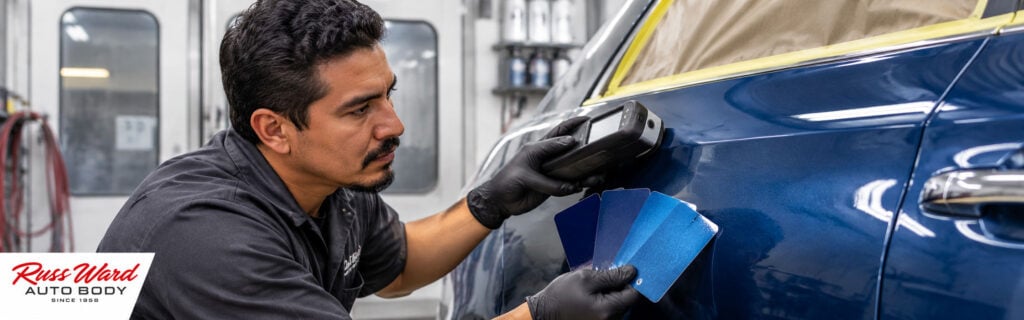
- Measure the color.Many shops use a spectrophotometer, a handheld device that reads the color of your existing paint and helps choose or adjust the formula.
- Mix to a computerized formula.The paint is mixed by weight on a precise scale using the manufacturer’s formula, with small tints added if needed.
- Make a spray-out card.Before painting the car, the technician sprays a test card using the same process and compares it to the car under daylight and color-corrected lights, from different angles. If it’s off, the formula is adjusted and a new card is made.
- Blend into adjacent panels.Instead of stopping the new color at the edge of a repaired panel, the technician gradually fades it into the neighboring panels. This makes small differences invisible to the eye.
- Apply clear coat and finish.A clear coat protects the color and sets the gloss. The finish is then cured, and polished as needed, to match the texture of the original paint.
Blending: Why Your Estimate May Include Undamaged Panels
Drivers are sometimes surprised to see an estimate that includes painting a panel that wasn’t damaged. That is usually blending. For example, if your front door is replaced, the technician may blend color into the fender and rear door so all three panels look the same. Blending is a standard part of a quality refinish and is commonly included in insurance estimates when needed for a proper match.
What to Check When You Pick Up Your Car
- Look at the repaired area in direct sunlight, not just under shop lights.
- View it from several angles: straight on, from the front and from the back.
- Compare the gloss and texture as well as the color.
- Check panel edges, door jambs and trim for overspray.
A good shop will welcome a walk-around and stand behind its paint work.
Do You Even Need Paint?
Not every dent needs new paint. If the factory finish isn’t cracked or chipped, paintless dent repair may be an option that keeps your original paint. Learn the difference in our article on paintless dent repair vs. traditional repair.
Expert Auto Paint in Anaheim
Russ Ward Auto Body has been refinishing cars in Anaheim since 1958, from daily drivers to classic cars. Our auto body paint and refinishing team uses careful color matching, test spray-outs and blending to make repairs disappear. Paint is often the final step of a complete collision repair, and we work with all major insurance companies on your claim.
Call (714) 535-3739 or request an estimate. Visit our main shop at 126 W Elm St, Anaheim, or our Estimate & Drop-Off Center at 2744 E Chapman Ave, Orange.
Frequently Asked Questions
Can a body shop match my car’s paint exactly?
A skilled shop can make the match invisible to the eye by combining the right paint code variant, a spectrophotometer reading, test spray-out cards and blending into nearby panels.
Why does my estimate include painting panels that weren’t damaged?
That is usually blending. Fading the new color into adjacent panels hides tiny shade differences, so the repaired panel doesn’t stand out.
Where do I find my car’s paint code?
It is usually on a label in the driver’s door jamb. On some vehicles it is under the hood or in the trunk. Your shop can also look it up using your VIN.
Why is white or pearl paint harder to match?
Many whites and pearls are tri-coat finishes with a base coat, a pearl mid-coat and a clear coat. The mid-coat changes how the color looks, so matching takes extra test cards and skill.
How long should I wait before washing or waxing new paint?
Follow your shop’s instructions. Many recommend hand washing only for the first few weeks and waiting longer before applying wax, so the finish can fully cure.